Early Office Museum
Antique Staplers & Other Paper Fasteners
Expansion in the volume of papers generated and stored in offices during the second half of the
nineteenth century created a demand for efficient ways to fasten papers together. As part
of our research at the Museum, we have investigated the development of early
staplers and other mechanical devices
that were sold to meet this demand between the 1850s and early 1940s. The
old paper fastening machines
discussed here were used not only to insert and clinch staples but also to insert other
types of paper fasteners, such as eyelets, and to attach papers together without the use
of fasteners by cutting and folding or crimping the papers themselves.
Before Metallic Paper Fasteners: Metallic paper fasteners and machines to insert them began to arrive on the market in the late 1850s and were widely advertised from 1866 onward. Before these specialized paper fastening devices were available, the types of documents that today are stapled together were fastened in a number of ways that did not make use of metallic fasteners or mechanical devices. Papers were held together by any one of the following:
1. Stitches made with a needle and thread2. Paper or wax seals or wafers (which were marketed for use in sealing envelopes)
3. Strings, cloth tapes, or ribbons that were inserted through parallel incisions made with a penknife, then tied, and sometimes secured with paper or wax seals to prevent tampering with the document
4. Lines or dots of paste or glue
5. Straight pins
6. Strings or ribbons tied around groups of papers
7. Rubber bands placed around groups of papers While metallic paper fasteners and machines to insert them caught on quickly, the seven methods of fastening papers that are listed immediately above were still used for decades. For example, in the early 1900s paper clips were sometimes advertised as a superior alternative to pins for fastening papers. Next we provide information about the 19th century use of a few of the methods of fastening papers listed immediately above.
Needle and Thread: A document published in 1858 states: "The Candidates should leave their answers at their seats (with the Examination papers attached to them), after having carefully filed them all together in order through the upper left hand corner. A supply of silk twist and some large needles should be provided for this purpose." (Journal of the Society of Arts, v. 6, London, England, 1858, p. 577)
Sealing Wax: Sealing wax was used to authenticate and seal documents long before the 19th century. In the 19th century, F. M. Butler of New York, NY, exhibited sealing wax at the Exhibition of the Massachusetts Charitable Mechanic Association, Boston, in 1837. Waterlow & Sons, London, exhibited sealing wax in 1855, and Thaddeus Davids & Co., New York, NY, did so in 1876.
Paste and Glue: It seems likely that lines and dots of paste and glue were used to fasten papers well before the 19th century, but our research goes back only to the second half of the 19th century. The following question and answer appear in 1860 testimony: Question: "Did the paper handed to you in the saloon in fact consist of two papers attached together by mucilage?" Answer: "It did." (Miscellaneous Documents of the US House of Representatives, 36th Congress, 1st Session, Mis. Doc. No. 12, 1860, p. 52) Mucilage, a water-soluble glue made from plants, was advertised along with other office supplies by Richard B. Dovell's Son & Co. and by Samuel S. Stafford, both New York, NY, in 1867, and by Carter Bros. & Co., Boston, MA, and Chase & Bush, Philadelphia, PA, in 1868. A number of sellers exhibited mucilage along with other office supplies at the 1876 International Exhibition. At least as late as 1912, well after numerous types of metallic paper fasteners had been placed on the market and widely adopted, mucilage was promoted as an alternative to paper clips for fastening papers. See the image on the right immediately below.
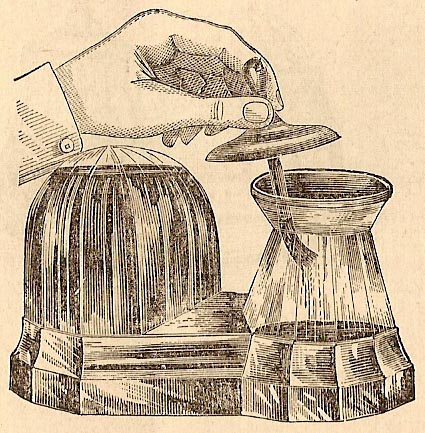 Morgan's Mucilage, 1881
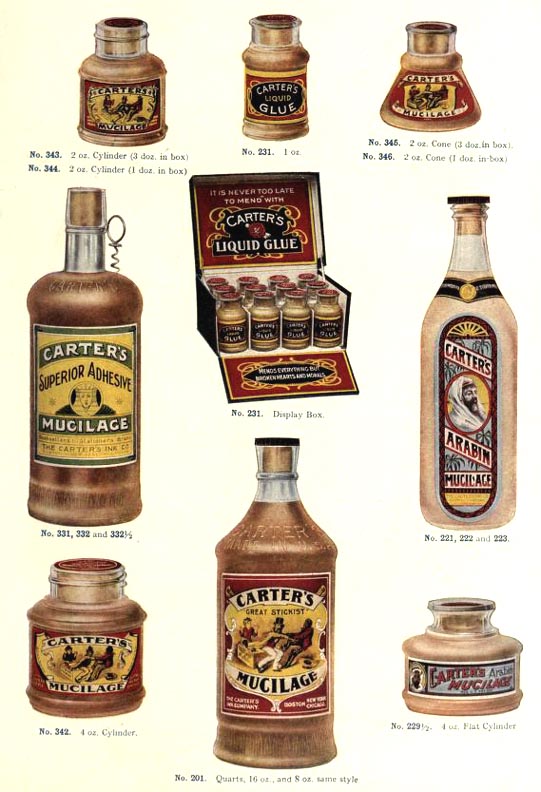 Carter's Mucilage, 1911
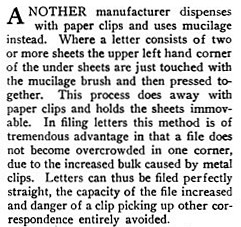 Mucilage Compared to Paper Clips, Business, 1912
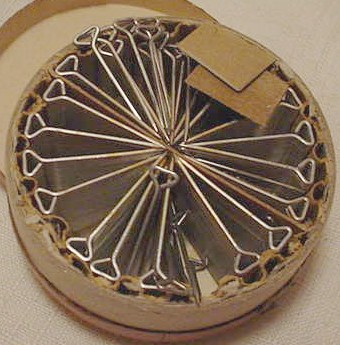
Straight Pins: Mass production of straight pins began in the first half of the 19th century, and it seems likely that straight pins were used to fasten papers once they were mass produced if not before. The photo below shows Pyramid Pins of the type sold for fastening papers in offices as well as for many uses in homes by the New England Pin Co., Winsted, CT. In 1878, Charles J. Cohen, Philadelphia, PA, advertised Pyramid Pins in a similar circular holder patented in 1871. An an ad for Pyramid Pins in a circular holder with a label similar to that in the photo here appeared in 1910.
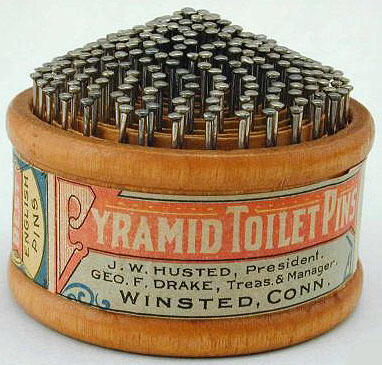
Pyramid Pins
Red Tape: The earliest reference we have found to use of red tape to tie papers is: "a bundle of papers, ty'd with red tape." (The Proceedings at the Sessions of the Peace, and Oyer and Terminer, for the City of London, 1730, p. 245) However, the use of red tape to tie a book containing notes and papers in 1708 suggests that red tape may have been used to tie papers by the very early 18th century. In any event, 19th century publications--particularly British ones--make many references to use of red tape for tying papers. The term "red tape" was used in its current figurative sense by 1833: "He hates the projects for centralising every thing in London, and putting the government of red tape and green ferrit in place of the time-honoured institutions of King Alfred." (Fraser's Magazine for Town and Country, v. 8, Oct. 1833, p. 488. Green ferrit or ferret is string or tape made from silk filaments and dyed green. In Britain during the 19th century, particularly during the early 1800s, it was sometimes used in the same manner as red tape.) The image below on the left shows an 1880 advertisement for red tape and green silk ferret along with other types of office supplies.
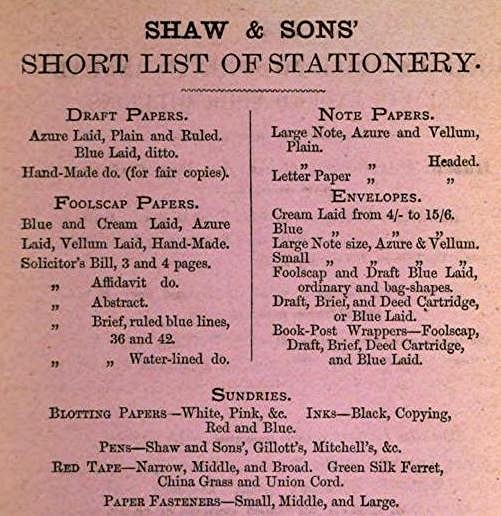
1880 Advertisement for Red Tape and Green Silk Ferret
Rubber Bands: Charles Slack states that the British firm Perry & Co. introduced the rubber band in 1844, and that a licensee of Goodyear made rubber bands around the same time in the US. (Noble Obsession: Charles Goodyear, Thomas Handcock, and the Race to Unlock the Greatest Industrial Secret of the Nineteenth Century, 2002, pp. 144, 155) We found Perry's India rubber bands being offered for sale, along with stationery supplies, including wax and wafers for sealing envelopes, by a company in Calcutta, India, in 1848. (D'Rozario & Co.'s Library. Books, Pictures, Stationery & Miscellaneous Articles, Calcutta, 1848) We also found references to India rubber bands among office supplies in publications throughout the following decades. Waterlow & Sons, London, advertised pins, elastic bands, and red tape in 1855. Geo. N. Davis & Brother, Boston, MA, advertised rubber stationers' bands in 1856. (Illustrated and Descriptive Catalogue and Trade-Price List of India Rubber and Gutta Percha Goods)
Brass Paper Fasteners: H. W. Hall received an English patent for a brass paper fastener with two legs that the user inserted through a slit in papers and then bent outward in opposite directions. Unaware of the Hale patent, the US patent office awarded a patent for a brass paper fastener with the same fundamental characteristics to George W. McGill in 1866. The McGill paper fasteners were immediately popular, remained popular well into the 20th century, and (under other brand names) are still on the market.
Paper Clips: In 1890, a paper clip made from folded spring steel was introduced in the US. A bent-wire paper clip was patented by Fay in 1867 but the Fay design was not used commercially until 1896. The first paper clip made from bent spring steel wire to be marketed was the Gem, introduced by Cushman & Denison in 1892, and ever since the most popular paper clip in the US. To visit our exhibit on the History of the Paper Clip, click here.
Paper Fastening Technology Timeline
This table provides a chronological list of paper fastening technologies that were introduced after 1850. For most, there is a link that will take you to a separate page with a timeline for that particular technology.The word "stapler" was used in its modern sense by 1884. (The American Bookseller, June 2, 1884, p. 547, referring to the Novelty paper fastener as the "Novelty stapler.") However, prior to the 1920s, the devices that we now call "staplers" were generally referred to as "paper fasteners," "staple drivers," "staple binders," and "stapling machines."
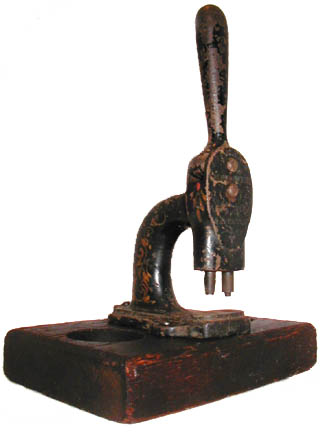
| 1850s ~ Eyelets: The photo to the right shows Lipman's Improved Eyelet Machine, which was advertised during 1878-85 for fastening papers. Hymen L. Lipman was awarded a patent for an eyelet machine in 1854. His 1854 machine had predecessors for fastening papers. According to the 1854 patent: "In eyelet machines as at present constructed, the eyelet cannot be riveted from one side, and the consequence is that after it is partially riveted from one side, it must be turned over, and completed. To those who use these machines, this difficulty of turning over the folios is obvious, as they are obliged to let go the sheets to be fastened, and they frequently get out of place." Lipman exhibited his eyelet machines at the 1876 International Exhibition in Philadelphia. Eyelet machines that were used for fastening papers, as well as for other purposes, were sold in the US until at least 1999. To see more eyelet presses, click here. |
|
|
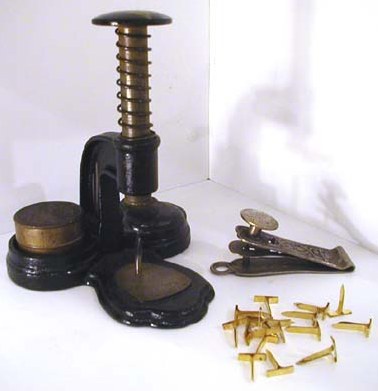
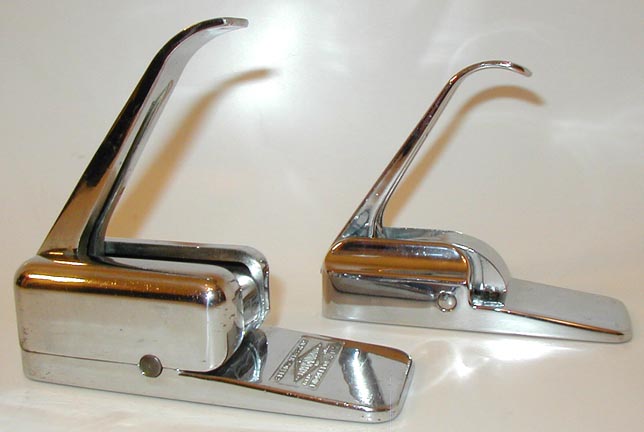
1860s ~ Brass Paper Fasteners: Metal paper fasteners similar to the brass ones in the photograph to the right were patented in the US in 1866 by George W. McGill. "Brass paper fasteners, 25 cts. per box" are listed among the purchases for members of the 1869 Illinois Constitutional Convention. In 1867, McGill patented a press designed to cut slits in paper so that fasteners of this type could be inserted by hand. The larger device in the photograph is a McGill Fastener Press similar to the one patented in 1867. It was advertised as early as 1880. The smaller device is a McGill Fastener Punch patented in 1874. McGill exhibited paper fasteners, and presumably paper fastener presses, at the 1876 International Exhibition in Philadelphia. To see more paper fasteners and paper fastener punches, click here. |
|
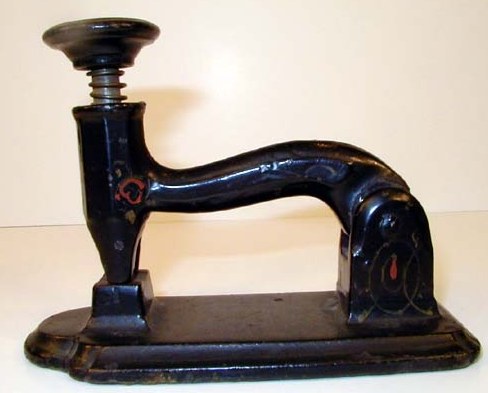
| 1870s ~ Individual
Preformed Staples: The first desktop machine designed to fasten papers
by inserting and clinching metallic staples was patented in 1877
(US. Patent No. 195,603). A
number of the earliest machines held only one
preformed wire staple at a time and had to be reloaded each time they were used.
The photo to the right
shows one such machine, a McGill Single-Stroke Staple Press No. 1, which was
patented in 1879 and advertised during 1880-1909. To see several single-staple machines, click here. OldStaplers.com, a web site that is no longer active, reported that in 1868 and 1874, before the development of machines that both inserted and clinched staples, two patents were issued for machines that inserted, but that did not clinch, staples. |
|
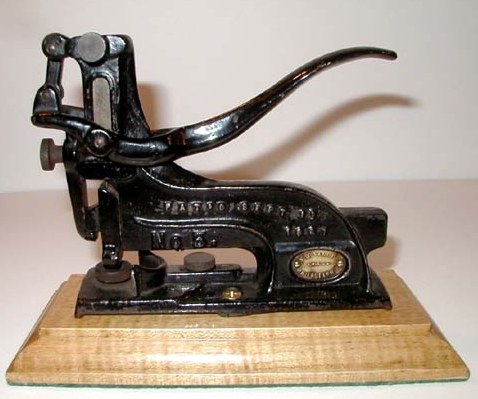
| 1870s ~ Magazines of Preformed Staples: The first stapling machine with a magazine that held a supply of preformed wire staples that were fed automatically to the staple-driving mechanism was patented in 1878. The Brown No. 5 Stapling Machine in the photo to the right was patented in 1887. To see a number of additional early magazine stapling machines, click here. |
|
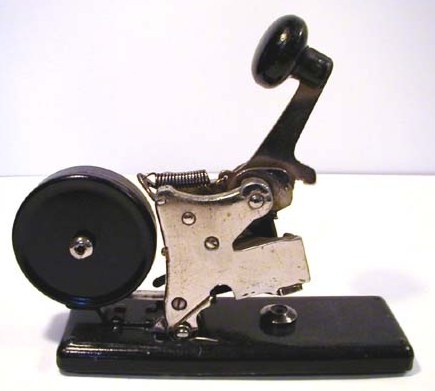
| 1880s ~ Staples Formed from Spools of Wire: A desktop stapling machine that formed staples from wire loaded on a spool was patented in 1880, and machines of this type were advertised as early as 1882. The photo to the right shows a later machine of this general type that used a spool of metal tape, the Eveready Paper Fastener, which was patented in 1915 and advertised during 1916-42. To see several other wire spool stapling machines, click here. |
|
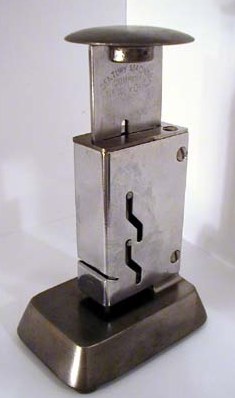
| 1890s ~ Staples Cut from Strips: Moving along the paper fastener time line, stapling machines that cut individual staples off a stamped strip of connected metal staples were introduced commercially in 1895 by the Jones Mfg. Co., the predecessor of the E. H. Hotchkiss Co. The photo to the right shows the earliest of these machines, the 1895 Star Paper Fastener. The best-selling strip staple machine, the Hotchkiss No. 1 paper fastener, was still marketed in 1950. To see a number of other strip staple machines, as well as the staple strips they used, click here. |
|
1890s ~ Staples
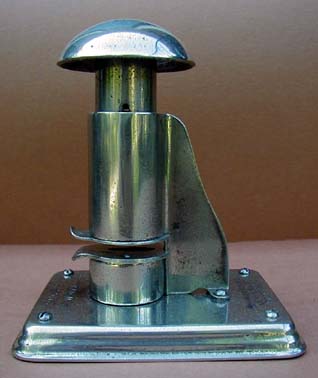
Formed from Straight Pins: The Century Stapling
Machine, which was patented in 1897, and the similar Sun Stapling
Machine, which was invented by the same person, formed staples
from straight pins by cutting off the ends, bending what was left to form a staple, and
then inserting and clinching this staple.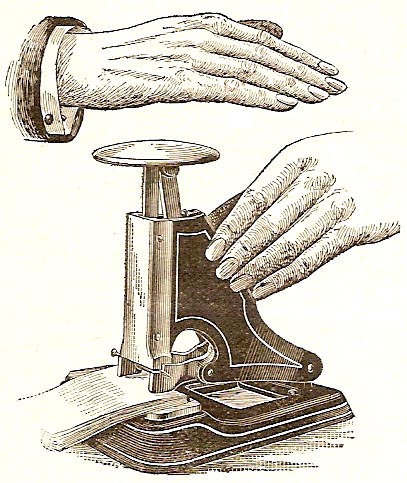 Sun Stapling Machine, Sun Typewriter Co., New York, NY, 1900 ad. 1900 Price $1.50.
 |
|
| 1900s ~ Fastening
Papers without Metallic Fasteners: “Stapleless” paper fastening devices that did not
use a metallic fastener were introduced in 1909 by the Clipless Paper Fastener Co. and
in 1910 by Bump’s Perfected Paper Fastener Co. A Clipless Paper Fastener and the
Bump Paper Fastener
cut and fold small flaps in the papers
in a way that locks the papers together. Bump machines were still
marketed in 1950. Curiously, the model of the Bump Stand
Machine that was introduced in 1916 was sold until 1950 with the
words "Patent Pending." The Paper Welder, which was introduced in 1941, crimps papers together. To see more stapleless paper fasteners, click here. |
|
| 1910s ~ Fastening
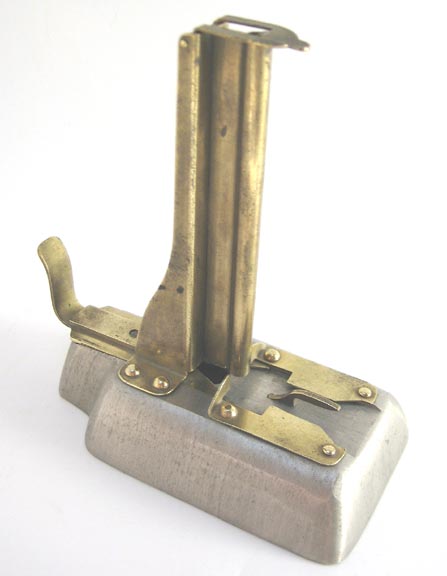
Papers with a Machine that Inserts Bent Wire Paper Clips: In 1914,
a device was introduced that pushed Niagara
bent-wire paper clips onto sets of papers. See photo to right. In 2003, ClipMagik
introduced an Electric Paper Clip Machine, which pushes Gem paper
clips onto sets of papers. To visit our exhibit on the History of the Paper Clip, click here. |
|
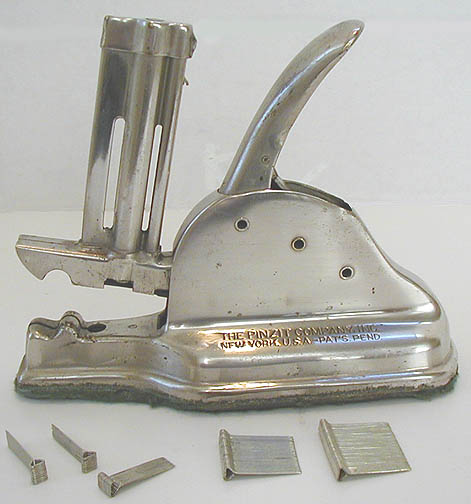
| 1920s ~ Fastening Papers with a Machine that Inserts Straight Pins: In 1926, the Pinzit Co. of New York, NY, introduced the Pinzit machine, which inserted a special straight pin through a set of papers. The device first bent the papers so that the pin moving in a straight line would pass through the papers from the top and then pass through the papers from the bottom. |
|
|
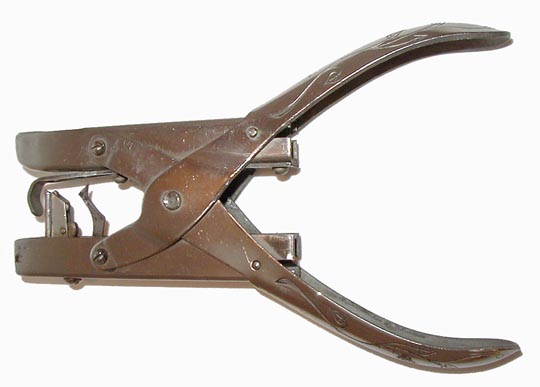
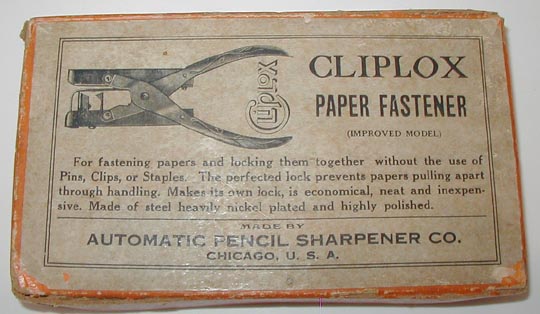
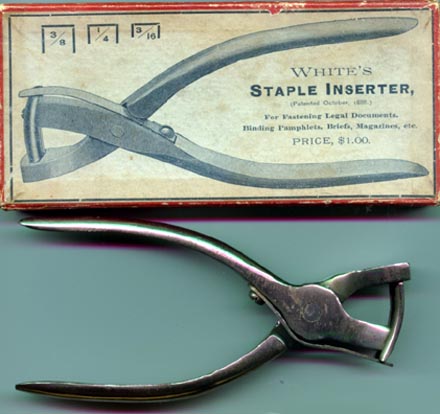
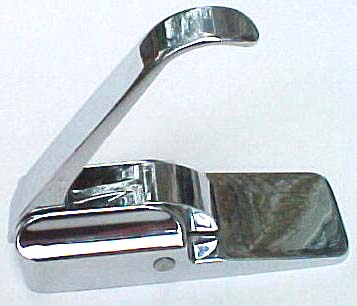
Hand-Held Paper Fasteners: We have not yet included hand-held devices in most of the Early Office Museum's paper fastener exhibits. Most paper fastening technologies have been available in both hand-held and desktop models. The 1888 White's Staple Inserter pictured to the right used individual preformed staples. It was marketed for "Fastening legal documents, binding pamphlets, briefs, magazines, etc." The 1915 Cliplox Paper Fastener pictured below was used "for fastening papers and locking them together without the use of pins, clips, or staples."
|
|
|
When Did the Magazine Stapler Become Dominant? Nearly all the
technologies described above co-existed for many years and were still marketed
at least as late as 1940.
In the end, staplers with magazines of preformed wire staples drove nearly all other paper fastening devices from the
desktop. We cannot demonstrate causation, but it is possible to suggest several reasons that magazine staplers won out after many
years of co-existence. |
. |

 Niagara Clip, 1897